Monday, 20 December 2010

SEEIN' SPECTRES IN MY DREAMS


More things that appeared places other than here! Two review pieces, and one interview, published in various issues of a student newspaper...


First up it's Small Black's New Chain. This one (I think) largely escaped the editorial scalpel, save for a few semi-colons and hypens.

"It feels unfair to be dismissive about Small Black's first LP: there's nothing that can be pinpointed as obviously wrong; there are no unforgivable faux-pas or embarrassing missteps. The problem, if you can call it that, is that New Chain is just... okay.

Individual elements are inoffensive enough: drum machines are set firmly at 'early '80s', the synthesizers are acceptably lo- in sound fidelity, and the vocals are 'badly' recorded to the point of being largely unintelligible. When heard in isolation, some of the tracks are even quite good: 'Camouflage' packs epic drums and none-too-subtle Joy Division nods, while 'Goons' happily clatters away for two and a bit minutes. But over an album, Small Black just fade into the background. They seem to have missed the fun of the era they pastiche so faithfully; there's none of the camp sense of humour or self-awareness that still makes early synth-pop beguiling. And without this playfulness, New Chain ends up as aural wallpaper: not unpleasant, but nothing to get fired up about either."


Weekend's (rather bloody good) Sports.

"On first listen, Californian shoegaze trio Weekend's début LP Sports is kinda bemusing: it's hard to escape thinking that the thick waves of static clouding every track are somehow accidental, as if 'it just happened that way' when recording. But first impressions can wrong-foot; on second listen, one realises that the 'accidental' feedback is totally the point, and serves as counterpoint to the band's obvious knack for writing pop songs: highlight "End Times" could've been written by C86er-than-thou label-mates The Pains Of Being Pure At Heart- if it weren't for ear-splitting noise obscuring the melodies. And though not exactly a new idea, this struggle between violence and sweetness still results in a thrilling record. It does help that the Sports' 45 minutes are packed full of sly twists; it's these little touches that move Weekend from 'faithful shoegaze pasticheurs' to 'something special'. Take the breakneck, charge at the end of "Veil"; the transition from the (appropriately) droney "Monday Morning" into thrashed-out "Monongah, MV"; the tactile waves of fuzz piling over the vocals on opener "Coma Summer"- the more you listen, the more you find."


And an interview with Jimmy Smith, one of Foals' two guitarists. This is rather a long 'un, and was written under stressful circumstances
(to say the very bloody least). In truth, I have no idea how it got finished, and it's probably riddled with errors, but, nevertheless...

"The Oxford-bred five piece that emerged from myspace (remember that thing?) three years ago were quite a different beast from the band we see today: back then, nervy guitars, obtuse lyrics and songs that were frankly claustrophobic prevailed. Insularity was the order of the day: indie-disco baiter "Cassius" pretty much stonewalls any lyrical analysis, for example- and this isn't even starting on Yannis Philippakis' yelped vocals, or the studio-tomfoolery heavy finished record. I mean, I liked Antidotes. I liked it a lot. But it was hard work. Two years down the line, however, and a great deal has changed...

It'd be a pretty horrendous cliché to say that with age comes maturity, especially when one factors in the fact that the time elapsed since Foals' début album Antidotes is- just to reinforce the point- a smidgen over two years. But like most clichés, it carries a certain amount of truth: the band's second record, Total Life Forever, released earlier this year, is a far less alienating affair than their first effort- as guitarist Jimmy Smith says, 'it's more open; there's more space on it'. It certainly sounds more comfortable, more assured than their début- but the reasons for the band's shift in sound, however, was actually as much by accident as design. Circumstantial factors- namely 'living together in a semi-detached house next door to a young family'- forced the group to shift their focus, 'moving from volume to sound', with various band members 'often playing quite quietly, quite late into the night, without drums', and writing songs individually.

This approach stands in stark contrast to both the recording of their previous record and demos made in the writing process: early demo track "Glaciers" involved 'Yannis getting stoned out of his mind' in a tiny studio in London, and piling tape loops on top of tape loops, which is '[what
Total Life Forever] would've been like if we had been allowed to have done loads of overdubs in the studio'. The tendency to exploit the studio has hamstrung Foals before: "Big Big Love" from Antidotes 'was just totally unplayable live. Total overdub central'. The band members' desire to use anything and everything available to them when recording was something producer Luke Smith had to actively fight: 'There's a tendency in the studio to want to do everything. There are all these instruments lying around... and [when we suggested using them] he was like "there's no way you can do that live, and it'll sound fucking terrible; just leave it... Leave that space empty!"'

Instead, at the behest of their producer, they returned to basics:
TLF is 'just the five of us, playing in a room'. Recording the album turned into quite a gruelling process, however- attempts to 'get the heart of the song' onto tape often meant doing 'twenty five, thirty, takes in a row... you'd start hallucinating, feeling really weird, completely out of it. Then the track finishes, and you've been playing for six minutes, and... "CRRK! Do it again!"'

Dispiriting though it may have been to record, Foals' new way of doing things is paying dividends live: their set the night before 'was absolutely mental, the crowd were going nuts'. In Bristol it's the same- and the music is of a consistently high standard, with new material often outshining the old. And for a band that once facetiously denied knowing any chords and effectively made guitar solos anathema, several moments in the set sound suspiciously lead-guitar orientated: distorted guitars duel in the segues before and after lead single "Spanish Sahara". Their new-found openness even manifests itself in the way the band plays live: whereas before singer/guitarist Philippakis and guitarist Smith faced each other across the stage, ignoring the audience, nowadays all members face front and centre. At some points they even smile.

It's not all positivity, however. A discussion of LA musician Ariel Pink's latest record quickly turns into a discussion of the state of the music industry- an establishment one gets the impression Foals are distinctly unimpressed with. 'I think the music industry needs a fucking huge revamp. It needs Laurence Llewelyn-Bowen to come in and sweep everyone away... All these traditions from the arena rock days, slapped on everything. It makes big bands really successful, but small bands have a horrible time...' Any latent teenage idealism about changing "the system" from within isn't forthcoming, however- Jimmy is adamant that, although he wishes 'the major labels would die', 'you've got to accept they never will... There are all these arseholes leeching off people, off bands'. It seems a rather curious position to be in, being supported by an institution you detest. Smith acknowledges the oddness of the situation, but says 'eventually you realise that it's about making music and playing shows, and concentrate on that'. Interpolating these statements to insinuate hypocrisy on Foals' part seems distinctly unfair, however: it's an issue faced by most musicians, and even more so when artists start to break into the mainstream. "Focusing on the music" might be ducking the politics somewhat- but it's also a pretty inevitable end-result.

And the band are doing their best to work make the process work for them- as they see it, 'the music industry is built on cycles... and once you're caught up in it, that's that'. Their next move, therefore, is 'to try and break our own cycles. Get the new album out quicker... Maybe do an EP. We've always wanted to do an EP.' This is offset, however, by an almost neurotic self-critical streak: 'we're so anal, and so worried about letting ourselves down musically... We've got a few ideas left , though. The well's not dry yet...'"

Sunday, 17 October 2010

NO MORE INDIE ROCK/ JUST A TICKING CLOCK

(David Shrigley, Time To Choose, date unknown)


First, some STUFF WHAT ACTUALLY APPEARED SOMEWHERE OTHER THAN HERE. (Albeit in radically attenuated form, with the insertion of a typo.)


[Exhibit A) A promised works piece on Life Without Buildings' one and only studio record, Any Other City, written for Bristol's student paper Epigram. Essentially, the promised works section is both a chance for my friend Jon to fill the paper with content, and for a writer to remind people why forgotten/ignored/underground album x is brilliant. TO WIT:]

"Life Without Buildings feel like one of those bands. The kind that should be renowned in the "right" circles. And they've got the credentials: only one studio album, little in the way of biographical detail, a painfully short career (1999-2002) and a singer that was (and is) by trade a visual artist. Instead, they largely dropped beneath the radar- which is rather a shame, because that one album, 2001's Any Other City, is something of a gem.

Honesty is probably the best policy here: I'm willing to wager your response to this album is going to hinge upon whether the singer annoys the hell out of you. Sounds obvious, right? The vocalist normally plays a pretty huge part in determining whether one likes a band. Well, hold that thought- the thing about Sue Tompkins' vocals is that they are really, really striking. Subtract 'em from this album's equation, and you're left with rather pleasant, vaguely krautrocky post-punk tracks. Add the vocals back in, however, and you have a rather different proposition: the compositions coalesce around this ever-changing, unique...

The only really apt point of comparison is probably Horses-era Patti Smith. Both clearly owe a great deal to the beat poets in terms of delivery, but whilst Smith's focus is upon stories, Tompkins hones in on the wuurds. She revels in them. The traditional verse/chorus pattern is totally abandoned- purely verbal digressions, pulling words apart into syllables, abound. She twists back upon herself constantly, too: phrases emerge, are repeated, forgotten, half-repeated, altered, picked apart, and variously howled, sung, whispered or simply spoken. And she's almost unique, in that quoting her lyrics outside of the song does little to aid understanding them: they defy easy deconstruction; demand to be listened to. If you want a laugh, check out the transcriptions on the internet: alone, they're ridiculous, but when heard with musical accompaniment, they make perfect, obtuse sense. Stand-out track Sorrow, for instance, has the guitar continually ramping up, fading out and dropping back in, providing an anchor for Tompkins' external/internal monologue covering pretty much everything. It is, quite simply, astounding. Any Other City has that rare kind of brilliance: it just demands repeated listens. So long, of course, as you like that voice..."


[EXHIBIT B) A review (now out of date, what with the record coming out a little while back) of Maps & Atlases' first full-length, Perch Patchwork. Of the two, this suffered more as a result of the editorial axe-waving, but it's not really anyone's fault. I should've written a better piece, Jon should've paid more attention, etc. etc. Anyway. Here 'tis:]

"Don't believe the hype: when Maps & Atlases say their début LP Perch Patchwork is 'more pop' than earlier releases, it doesn't mean much; they won't be Top 40 any time soon. They're still as inscrutable lyrically: I have little idea what the hell a "Perch Patchwork" is supposed to be (fish mosaic, perhaps?), or why being greeted by a pigeon is so portentous, but underneath those odd, nasal vocals so much is going on. Stop-start guitars; unexpected, inventive drum/bass stuff; strings; the occasional parping of a brass section; what I swear were pan-pipes- it's surprising, adventurous music. Take the pretty much drum-only The Charm, or the absurdly catchy Solid Ground- the whole record kind of feels like M&A flexing their songwriting muscles. And the result? Well, it's a marriage of experimental waywardness and hooky pop songs- and a pretty much brilliant to boot: equally obtuse and accessible."

RECENT ENTHUSIASM:

MUSIC
James Blake continues on his streak of awesome, and it doesn't look like it's gonna end any time soon, either. This is a cover of Feist's Limit To Your Love, with Mr. Blake's vocals (finally) front and centre.
It's also a month or so old (in terms of release) so I'm a touch behind, but never mind. See: that unfuckingbelievable gut-bothering sub bass part, and his really excellent (and I think more recent) Klavierwerke EP. Supergood.


Recent digging on a (ahem!) nameless website uncovered yet another gem of a band signed to Slumberland records: the fantastic Weekend. Just turn this the hell up: distorted guitars! Noise! Obscured vocals! Win! Their record Sports will be coming out soon, and IT WILL BE GOOD.

Weekend "Coma Summer" by Slumberland Records


In other news, I saw DOOM Saturday (he was excellent) and last night's entertainment came in the form of HEALTH supporting Crystal Castles. I was actually looking forward to HEALTH more, but Crystal Castles totally blew them out of the water. Alice Glass is unbelievably charismatic, and they are very, very fond of strobe lighting. This aside, I also saw No Age supported by Male Bonding- and it was a rare case of the support being vastly superior to the headliner. Still, it was cheap- and No Age's hilarious combo of sincerity and fondness for totally unnecessary swearing was totally worth the price of admission. Not to mention other amsuing things that happened in conjunction with my attending the gig, but they're both hard to explain and not especially funny for any party that wasn't present. So, best left unsaid. Let's not resort to in-jokes, here.

I also saw the wonderful Joanna Newsom supported by Roy Harper, but it was a long time ago, and there's no easy way to express just how incredible Ms. Newsom was. The set was skewed in favour of Have One On Me (no bad thing) and featured some of the best live drumming I have ever, ever seen. Just... wow.

BOOKS
Term's recently gotten underway, so reading purely for pleasure (though philosophy is undoubtedly fun, it sometimes infuriates...) is kind of out of the question for the next little while. The last book to be completed was Jerome K. Jerome's Three Men In A Boat, which I enjoyed very very much. More in depth analysis may come later, but for now: it made me chuckle.

The current project is Virgil's Aenid, but that will more'n likely take an age, and it'll be an age before I can find enough time to actually read the damn thing. So, I suppose it goes.

Wednesday, 29 September 2010

RECENT ENTHUSIASM// 4. Come on feet!


(Lily Van Der Stokker, title and date unknown)


So, I haven't done one of these in a while. I've been a little busy. Up and down the country, busy writing stuff that might actually be seen, sorting out a house and a society... But anyway, these are no excuses. Rough recent interesting stuff rundown...

MUSIC.

Listening has been mainly hip hop. A list of names would just be boring, so here's a few videos instead:

Quasimoto- Greenery.
Way-out there stuff from Madlib, released under the pseudonym Quasimoto/ Lord Quas. The voice is... distinctive, to say the least. Fun, kinda goofy, playful stuff. His first record is probably more consistent, but this track from his second (The Further Adventures of Lord Quas) gives a pretty good idea what to expect: dreamy, but not necessarily nightmarish. Also: track Jazz Cats Pt. 1, though not outstanding as a song, is such a good rundown of quality jazz artists. I've been using it as a springboard for finding stuff, and I recommend you do the same. Now.


Earl Sweatshirt- EARL
From the so-extreme-it's-just-cartoonish crew Odd Future (or, as they some times insist on being called, OFWGKTA (or Odd Future Wolf Gang Kill Them All. Yeah.)) comes Earl Sweatshirt. I make no bones about it: both lyrically and in terms of the video's content, this stuff ain't for queasy stomachs. But it's also (once you get past the aforementioned violence) brilliantly produced- kinda unique, and hard to pin down. A bit lo-fi, with fantastic detuned synth lines and meandering raps packed with genuine 'what'd he say?!' moments. Free downloads of various mixtapes available from their tumblr, here. Their approach is kinda like a new Wu Tang-Clan: one group album, and various mixtapes from the respective members, all masterminded by 'the creator' Tyler. Domo Genesis' Rolling Papers is excellent, but as far as I can tell they're all worth checking out.


And (another) DOOM alterego, Viktor Vaughn. This's the title track from his not-so-recent Vaudeville Villain. Straight up awesome, with one mother of a groove. Obviously, if one hasn't, one should also give the DOOM/Madlib collaboration Madvillain a listen as well, because Madvillainy is packed full of genius, but DOOM's entire back catalogue (except, possibly, Dangerdoom, which is fun but rather insubstantial) rewards digging. Further updates as I get acquainted with the aforementioned back catalogue are to be expected; I'm not saying I know it all here- just that, currently, I haven't heard Daniel Dumile do anything terrible.


Recent gig-going has been embarrasingly lax, but I did manage to catch the (overpriced) Ducktails at the Cube. Bearing in mind I hadn't bothered to listen to their recorded stuff (which, according to two out of the three people I went with, is much better than the live show), the gig was massively, massively underwhelming. Every track felt sub-something else, and weirdly half-finished. The songs seemed somehow malformed- like someone had started writing a song, got bored halfway through and raced through the process. Again: I haven't listened to the recorded stuff, but on the basis of that gig, I don't feel at all inspired to search it out.

But the frontman was likeable enough, and his backing band was the rather good Spectrals, so it wasn't all bad- just a bit dull.

BOOKS.


Dostoyevsky's The Brothers Karamazov and Dante's Inferno both got polished off in quick succession. Well, I tell a lie- the Dostoyevsky's been on the go for quite a while, but I got inspired and chewed through two thirds in a week or so. I don't think I can say anything particularly insightful here: both books deserve the status they have, and they're both a bit too weighty to analyse pithily.

So, instead: a quick thumbs-up for a little book of two lectures by the wonderful John Ruskin. Called On Art and Life, and available as part of Penguin's Great Ideas series, Ruskin is consistently charming, especially in the second piece- a lecture delivered on the subject of iron. It doesn't seem too unreasonable to get a high dose of cultyah for ~£3.50, does it? No. So go buy.

Tuesday, 7 September 2010

MUSICAL POLITICS & THE ENGLISH LANGUAGE


(Francis Bacon- Three Studies for Figures at the Base of a Crucifixion, 1944)

(Or: everyone's a critic: 'net journalism gets uglier.
Wherein things get heinously meta-, and a site reviewing reviews (kinda) gets reviewed.)

Writing about music is difficult. Zappa wasn't far off with the "dancing about architecture" similie- and yet, people persistently try. Just look at this blog, fer heaven's sake- trying to articulate why I like certain things without coming across as a tool (at least I hope I don't, but I'll leave judging there to you) isn't easy anyway, and it's much harder when it comes to music. There's something ineffable about albums I really love, and often it defies any analysis other than 'this makes me feel good inside'. This ineffability thing makes music journalism as a whole quite tricky: you're trying to convey something that's in a deep sense personal; quite literally subjective, and also doing so in a way that's interesting or persuasive, or at best both.

Which makes a website called ripfork, the1 scourge of the independent music2 critical machine, kind of interesting. It's safe to ripfork is rather unimpressed with the current state of music criticism- and its targets are the frequently overblown3 record/gig reviews from 'sites like pitchfork, drownedinsound et al. The reviews of reviews are close to medical diagnosis4: various language ailments are 'revealed' through close analysis of the review. And it's tricky not to write this piece in a way that's self-justifying or weasely or trying to remove myself from the 'bad journalism' camp (because I'm pretty sure I've been guilty of some of the things Wendus indicts others for), but I'll give it a shot- because there's some intriguing fall-out stuff about music, criticism and the English language that I think results. So: hear me out.

The root of Wendus' occasionally quite vitriolic attacks is quite a simple one, really: people hiding that they don't have much to say behind otiose verbiage.5 It's a pretty old problem; Orwell took "vague language" to task in the wonderfully concise Politics and the English Language of 1946. After all, words offer the means to meaning, to communication- and vague language communicates a lot, although admittedly probably not exactly what the author originally intended. In part, vagueness seems like a kind of bluffing mechanism: hiding the fact that you haven't got much to say. Sort of like the emperor's new clothes gone apeshit, with a thesaurus in hand.

This is all well and good and kinda admirable. But Wendus seems to want to go further: his mission, as far as I can tell, is to stop music journalism in its entirety. Don't think I'm exaggerating here: frequently calling journalists "music lice" and exhorting them to create music of their own just seems boneheaded. It's something that isn't helped by the frequent (and kind of unnecessary) personal attacks. There's two separate things running alongside here, but together they undermine what could've been a brilliant website and a really important point.

First, the personal attacks: I'm gonna take it for granted that a lot of independent music websites and their journalists frequently go for the musician and not the music. This is regrettably part and parcel of the scene. But in insulting those that insult, the moral high ground isn't just lost, it's totally forgotten about. Argument ad hominem pretty slams the brakes on any kind of productive dialogue, and it just feels like an attempt to score easy points. Anyone can be rude on the internet. It's... cheap.

And the "why don't you stop criticising and create" thing, a favourite of the critically maligned artist since time immemorial is just stupid. However dire a state it may be in now, criticism still does act to filter out the crap and reveal otherwise hidden gems. Of course it isn't perfect, but it's useful. Denying that is just blinkered and retrogressive.

I'm not going to go as far as Wilde did in The Critic As Artist and say that criticism is more valuable than art itself, but I certainly think that it- when done well- can be incredibly interesting. And Ripfork highlights the problem with a lot of the criticism about: it's boring and obfuscating and a chore to read. It's not really any wonder I frequently skip the reviews and scroll down for the star/needlessly precise points rating6; that's become the important bit, not the opinions of an informed and amusing music fan- which, if you think about it, probably should be the thing that matters.

What I think we need are more people unafraid to use the personal pronoun I, more reviewers that talk in plain English and avoid excessive genrefication7. More people like DiS's bloody marvellous Wendy Roby, or the wonderful Simon Price. Criticism can be great, despite what Mr Wendus says.

1 (or at least, a)

2 The temptation to put this in scare quotes was huge, but I valiantly resisted. Very broadly, I mean: the people interested in independent music, either in terms of record-label ownership or "spirit", and focused primarily on bands often not particularly commercially successful. This is a rough definition, but I'm sure you can guess the people and musicians I mean. A clue: it's not bands like The Killers. There's some serious worm/can/opening that has the potential to go on here- especially about why the indie community is the way it is. But, if this ain't mixing metaphors too much, I'll try to keep a lid on that stuff.

3 To say the very least.

4 If the person doing the diagnostic work was really, really angry at the patient.

5 I like the word otiose, okay?

6 And I think there's a pretty good case for just doing away with star ratings altogether. If nothing else, it'd force people to read the reviews.

7 The genrefying thing is a complete minefield, and I don't particularly want to venture into it right now- both sides have a point, but when your description runs to three or more hyphenated words, you should probably just stop...

Wednesday, 25 August 2010

TO THE LIGHTHOUSE...

(The rather lovely Patrick Wolf, photographer currently unknown. But regardless, I'm very fond of this shot.)

MUSIC
Extraneous personal stuff: I'm off to Cornwall for a few days in a few days, which means A) no pithy little pop culture nuggets for you, and B) Patrick Wolf's gorgeous second album Wind In The Wires for me. For the uninitiated: it's a record all about Cornwall, and I'm excited at the prospect of listening to it whilst zooming through the landscape it so beautifully sets to music. Here's the title track...


After stalking The Pains of Being Pure At Heart's Kip Berman on last.fm (findable here, if you're interested) and listening to his favourite tracks, I hit upon this absolute gem. Words just cannot convey how unbelievably cool this track is. There's just no other way of putting it. I give you Polaroid/Roman/Photo, by 'French synthwave[rs]' Ruth...


Also, and sadly not available on youtube, personal fanboy favourites Parenthetical Girls are set to release Part II of their Privilege 12" set soon. Part II is entitled The Past, Imperfect, and you can listen to the track Young Throats at this website heyar. (The frankly awful blather is simply not my responsibility; I link for the musc, and if that 'site poisons your mind I shan't be held accountable.)

Also, whilst I remember, and of course assuming you're interested, my last.fm can be found here.

______
BOOKS

Latest reading has been, newspapers and assorted articles aside, Wilde's The Critic As Artist. As far as I can tell, it's the fullest statement of his aestheticism, and crucially also a scintillating, wonderful read. It's in dialogue form, and often seems simply to be a vehicle for his infamous epigrammatic wit. I would talk on, but I don't want to spoil just how good it is for you. Well worth taking a day or two to digest and enjoy.

An online version is available here, but as ever I fear the printed word reads best when printed- your kindle/ipad/e-reader be damned. As a corollary: that version is 'unable to reproduce' the occasional bouts of Greek Oscar indulged in, so you will actually miss a fair bit of the dialogue's meaning. Yet another reason to get yourself to the bookshop.

Reading whilst I am away shall be: Dostoyevsky's The Brothers Karamazov, a book of Plath's poems, a book of essays on the philosophy of law, and nothing else. For now, goodbye.

"Let us go... and look at the roses. Come! I am tired of thought."

Tuesday, 24 August 2010

RECORD REVIEW// Tennis- Baltimore EP

I wanted so very dearly to hate Tennis: descriptions of their music mention how "lo-fi" this husband and wife duo are, the fact that they write songs about their boat trips- and so on and so nauseatingly forth. It seemed the perfect set up for a lambasting- I thought something about 'following the chillwave trend' could be employed; I believed I had a perfect storm of disgust to unleash 'pon their unsuspecting heads.

But the problem with preconceptions is that they often highlight just how wrong one can be; all thoughts of being rude were forgotten when I actually listened to this dinky little EP. Its three tracks all pack wonderful melodies swathed in a kind of summery haze, and beyond track titles, a few discernible lines and guesswork, I haven't really got the foggiest what these songs are about- and I couldn't give a fig. This EP, as Oscar might've said, is almost irredeemably charming- and at seven minutes 18 seconds it may have an insubstantial running time, but pray don't let mere appearances deceive.

Saturday, 21 August 2010

WE WATCHED WHITE STARS OVERHEAD

(David Hockney- A Bigger Splash, 1967)

As I've been working away and not achieving very much on a bunch of nowhere near finished pieces and ideas, here's some music:

FOALS- Brazil Is Here (b-side to the Balloons single)

It's kinda interesting that, for me at least, a lot of Foals' better songs are b-sides to the singles, or stuff that just never got released in any official way- and this is especially pronounced around the time of their first record. To wit: the track above, Unthink This, Astronauts and All, Gold Gold Gold- hell, even Hummer and Mathletics were single-only. Add to that earlier, much more math-rocky stuff like Try This On Your Piano (and the even earlier, unreleased, brillaint Modern Art Is For Pricks) and you have quite a sizable collection of quality music. Happy hunting- and if you haven't already, check out the now-sadly defunct sister band Youthmovies. Good Nature is a great, great album.

Hyetal- Phoenix
Hyetal - Phoenix - 002 by william orca

So, apparently Hyetal's (yet) another not-really-dusbstep, prodigously talented producer from Bristol. And this is an absolute gem: euphoric, brilliantly put together... It has everything I could ask for in a song. Plus the synth line that appears later in the song is quite simply one of the most lovely things I've heard all year. As someone I saw on a blog said: this stuff is weirdly close to electronica legend Vangelis, whose composing work on films like Blade Runner make for great albums in and of themselves. (Incidentally, of his studio records, my favourite is the wonderful Albedo 0.39. Well worth yr time, is Vangelis.)

Canzonetta Sull'aria, from Mozart's Le Nozze di Figaro.

Most famous for its rather memorable appearance in everyone's favourite film The Shawshank Redemption, this is a gorgeous little piece of music. Tellingly, I've been lead to believe the title translates to 'a little tune on the breeze', although this could be completely wrong.

To be perfectly honest, I never really got the deal with opera; I always was under the impression it's just a glorified, posh person's musical. This, obviously, is not correct, and I'm slowly coming around to the idea that it might actually be rather interesting. The costumes are still ridiculous, though.


Polar Bear- Peepers (live studio recording for The Guardian)

And a little ditty from London 'post-jazzers' (ololol) Polar Bear. I've talked about this band a lot before, so: this is a slightly longer version of the title track of their latest record, which I've been listening to a fair bit. Great stuff, and it's good to see Seb Rochford's hair remains as vertiginous as ever. (There's also a video of them playing Jools Holland, but the sound's a bit off: the guitar is waaay too high in the mix, and the band sound kinda flat. Shame, really.)

...and finally, a track I'll say nothing about, save the fact I've been playing it constantly. And Then He Kissed Me, by The Crystals. Magnificient, classic wall of sound Phil Spector.


LATE EDIT. OR, ONE MORE!
Beam Me Up, remixed by Jacques Renault, original by Midnight Magic.


This has one mother of a groove. From the guys and gals of Hercules and Love Affair, yet another disco revival slice of awesome.

Now, to listen to that Messiaen...

Sunday, 15 August 2010

RECENT ENTHUSIASM// 4. as long as forever is.


(Richard Long- A Line in Japan, Mount Fuji, 1979)

Twenty-four years remind the tears of my eyes.
(Bury the dead for fear that they walk to the grave in labour.)
In the groin of the natural doorway I crouched like a tailor
Sewing a shroud for a journey
By the light of the meat-eating sun.
Dressed to die, the sensual strut begun,
With my red veins full of money,
In the final direction of the elementary town
I advance as long as forever is.

(Dylan Thomas- Twenty Four Years)

MUSIC.
Mainly it's been Arvo Pärt's beautiful Tabula Rasa that's been e-spinning on my laptop recently. In a similar way to the fact I find my admiration for Caspar David Friedrich's overtly religious paintings a bit strange, in an abstract sort of way I feel I ought to find Pärt's music offputting, as again they're (supposedly) primarily religious in character. (He's been called the "foremost composer of minimalist devotional music" and this work in particular "the pinaccle of the 'Holy Minimalist' movement") But, as ever, abstraction ignores the music- and Tabula Rasa (literally: "blank/clean slate") is heart-stoppingly beautiful. The "religious composer" tag is, I think, something of a misnomer: I'm sure it informs his compositions a great deal, but it's not something I think I'd've guessed at hearing the pieces 'cold'. Rather, this is wonderfully concentrated, contemplative stuff: two violins, prepared piano; two movements- and to simply leap from 'contemplative' straight to 'necessarily religious' seems a tad lazy. Needless to say, the religious don't necessarily have a lock upon the concept of 'contemplation- regardless of the personal beliefs of the composer. Death of the author, innit!

Anyway. An exquisite little ocean of calm, and something I've been playing a great deal. It feels as though it manages to articulate the infinite wonder of the universe as a whole.

Below is first movement Ludus- my favourite of the two, the second, Silentium, I couldn't find whole on youtube.


_______

BOOKS.


In keeping with the whole 'infinity' theme that seems to have developed (and though not a particularly RECENT ENTHUSIASM), I'd like to talk a little bit about David Foster Wallace's wonderful novel, 1996's Infinite Jest.

It's hard not to merely recapitulate what many others have said about this book- there's certain salient features that kind of beg to be mentioned: the unbelievably extensive footnoting; the vivacity and inventiveness of Wallace's prose; the daring and brilliance of some of his conceits; the heinously complex and self-consciously surreal plot(s); its sheer length (w/footnotes IJ comes to something like 1100 pages, +/-)... It's a list that has the potential to be extended for a very, very long time: this book is brimful of ideas, devices, themes and just straight up hellaciously interesting stuff. To the point where, regardless of whether you actually enjoy the thing, as with any project of this scale, it kinda demands admiration, at the very least.1

So I'm kind of spoilt for choice as to what I discuss here: do I talk about Eschaton's hilarious mix of tennis prowess (large chunks of the novel are set in an academy for promising tennis players, by the way) and simulated global thermonuclear war utilising only tennis paraphenalia and a mobile mainframe computer? The (quite literally) lethally entertaining film Infinite Jest that gives the book its title, and attempts to locate said film by Quebecios separatists? The sly, constant parodying of (among a great many other things) latter-dayconsumer culture? The manifold and frankly bizarre subplots? The vividly sketched characters occupying the AA meetings and halfway houses that populate this tome? The ferocious sense of humour; the puns? Or even just pick apart grammatical things like the Wittgenstein-esque, ever-present '...', indicating a non-reply/lack of speech- or even, say, just the fiercely convoluted syntax? These are all important, probably vitally so, in explaining why I think the novel succeeds on so many levels- but I don't think, by and large, that they're the point.

Now a statement like that probably needs some unpicking, so here goes: all the 'postmodern-er than thou' stuff, DFW's "verbal high jinks"- they're kind of a side-show. They occassionally mask, and at other times reinforce, a wider, much deeper, and much more important message about human communication (and hence human experience), on a very basic level.2 Infinite Jest should, I think, be seen as the culmination of much of his work (both pre- and post-IJ's publication), much of which serve like great (in a physical size, rather than prestige/stature kind of way), separate expositional footnotes and illustrative addenda to IJ.3 Things like the Kenyon commencement speech, or the short stories The Depressed Person or Good Old Neon (which can be found both online and in the collection Oblivion: Stories) are primarily about "the existential angst that occurs when existential angst itself becomes a cliché",4 and at a very basic level how to deal with being alive.

It's something Jonathan Franzen pretty much nails down in the heartbreaking speech he gave at Dave's memorial service: his work is about exploring ways out of loneliness. It's about avoiding the "gut-level sadness" that seems inherent in Western culture. And it's certainly no accident that the unashamed, openly-accepted, comment-free 'sharing' that (apparently, I don't actually know for sure) goes on at AA meetings gets such frequent (if sometimes oblique) mention: that's, as I think he saw it, the main way to deal with the great (same sense of the word as above) destructive power of irony in rendering discourse lonely and essentially meaningless. If you're never sincere, never say what you mean, what does this add up too? And it's here that Infinite Jest's great (other sense, obviously) success is evident: espousing a basic message of sincerity, of unimpeded communication but doing it via the (literally) deconstructive tools of the ironist; using their own weapons in for a diametrically opposed purpose. You can see it in two therapist characters, one from IJ, one from aforementioned short story The Depressed Person: in the latter example, exaggerated to such an extent as to render the "value-neutral" approach taken is rendered ridiculous- it does the patient no good whatsoever, and exacerbates her condition; in the former case, Hal Incandenza's horrendously self-conscious approach to grief counselling totally impedes him from any kind of meaningful discourse.5 The artifice he erects stands between the two interlocutors, and it's no real wonder that Hal's a basket case. He's us- exaggerated, sure- but the essentials are all there. In both cases, and many others, Wallce is employing exaggeration to parody,-not to mention all the other staples of so-called 'maximalist postmodernism': incessant references to high and popular culture, rapid vaults through authorial register, authorial interruption, and etc. etc.- but for a purpose other than deconstruction. And this isn't even beginning to scrape the surface of much of Infinite Jest- and that, I think, is why it's such an essential book.

1. Admittedly the same is true of most immensely long novels- apart from those godawful fantasy ones that just go on and on and on, and that have characters named such that one gets a forehead-punchingly obvious distillation of that character's traits from name alone.
2. Again, what I'm saying here isn't a particularly new insight into the text, as you'll see when I start quoting people, but it's sure as hell an important one for understanding it, as far as I can see- especially when somewhere like Time Magazine gets it so spectacularly wrong. If there's one thing this book isn't, it's a "sendup of humanism at the end of its tether". Also, on this point, and many others, I'm especially indebted to Jon Baskin's fantastic essay on DFW, available here and probably a great deal more concise and interesting than this.
3. I mean, you could see it as the other way round, but that seems kind of obtuse and churlish- the smaller pieces, by definition, aren't a thousand pages long. Nothing screams 'defining, definitive artistic statement ahoy!' quite like length.
4. A turn of phrase I owe squarely to a wonderful article found here.
5. Again, a point owed the article of footnote #4.

_____

ART

(Richard Long- A Line Made by Walking, 1967)

Bristolian Richard Long's art isn't so much infinite as infintely beguiling: his subject, quite simply, is walking. Works are often stark descriptions of certain walks rendered without value-judgement, photographs of natural features rearranged subtly (see top) or altered (as just above) by the very process of walking, or the assembly of naturally occuring objects (rocks, primarily) into geometric, strangely pleasing patterns. It's oddly fascinating, and a lot more than it seems prima facie.

Saturday, 14 August 2010

ESSAY, I SAY!


(Thoughts on: David Foster Wallace's A Supposedly Fun Thing I'll Never Do Again, George Steiner At The New Yorker and Will Self's Feeding Frenzy.)

Just to kick things off with a caveat: this isn't an exact non-fiction compare-and-contrast matchup- of these three books, one (ostensibly) is largely about restaurant and architectural criticism, one chiefly concerned with the reviewing of books (and by extension, often the authors and their ouevre), and one a freely ranging high-speed meditation on whatever the hell takes the writer's fancy*. But there's a common theme: these three all, in their idiosyncratic ways, typify central features of that rather nebulous bunch: the polymaths. (Indeed, references to Steiner's purported polymathic nature occur, (implicitly or explicitly) five separate times in seven review excerpts on the back cover of ...At The New Yorker. Draw your own conclusions.) Their interests are wide-ranging, insatiable and often passionate: Self riffs on psychogeography, the Tate, food, and interviews Morrissey; Steiner wields unbelievably prodigious skill with languages: justified-looking critiques of translations from French, Italian and German (amongst others I forget) appear frequently, as does a seemingly inexaustible knowledge of the lit. canon (both modern and ancient); and Wallace tackles subjects massively disparate subjects: the Illinois state fair, the professional athlete as modern-day religious figure, holidaying on cruise ships and (possibly premature) critical exultations about "the death of the author". Everything seems to be grist for their respective mills.

And they all certainly make for invigorating reading- though often wildly different in style, each is certainly engaging. Steiner's prose is pellucid, his criticism sharp and exacting. Wallace is variously deliciously straight up, especially when discussing supposedly "difficult" topics ("The wicked fun here is to watch how Hix employs the deconstructionists' own instruments against them.") or wonderfully obtuse (the much vaunted "and but so" and variants; chunks of essay E Unibus Pluram: Television and US Fiction) and Self is... Well, he's Will. He leaps between evisceration (his skewering of Quentin Tarantino is just beautiful. Representative quotes: "... Mr. Tarantino is essentially a pasticheur and an artistic fraud"; "...I read Mr. Tarantino's script, and found it to be illiterate..." etc.), archly surreal reviews (a few pages on a place called "Bluebird" take the form of an hallucinogenically weird vignette where Self himself is briefly cradled by Terence Conran) and several surprisingly generous pieces on Oasis, among many, many others.

But there are similarities: both Self and Wallace are laugh-out-loud funny, and they also both often delve into their respective manic, ticcy styles. It feels as though both writers are but a few steps removed from the worlds of their novels: DFW's essaying tone is regularly set to the 'self aware, everything-but-the-kitchen-sink' level of information overload, a mere skip and a bound from the 'horrendously self-referential, everything-including-the-kitchen-sink-and-a-whole-lot-more-crap-you-never-even-noticed-before' data deluge of Infinite Jest or the short stories. Similarly, Self's frequent forays into frankly bizarre discursive wanderings** permeate his writing, fiction and non-. Steiner's erudite discussions are, by contrast, infinitely more restrained, often sticking to broadly the same formula: apparently tangental, unrelated introduction (sometimes drawn out (occasionally frustratingly so) to over two pages in length), the relevance of which becomes quickly apparent at the interesting picking apart of author/thinker/biographer/biographed stage, followed by a sucker-punch surprise ending, pithily summarising and adding to the above. (Viz: "[this collection of E.M. Cioran's aphorisms] does raise the question not so much whether the emperor has any clothes as whether there is any emperor.")

What all three do have in common, however, is an often overwhelming sense of fairness in their treatments of various subjects. I don't necessarily agree with all the conclusions that are reached by some (more on this shortly) but one feels that each writer is scrupulously careful and considered in their arguments and eventual conclusions. Wallace's frequent, horrendously self-aware admissions of supposed pretensions in his analyses of various phenomena, of being "abstract" or "arcane", or of beating around an ideological bush mask a seriously sharp mind: his even-handed simultaneous deconstruction of both the films of David Lynch and critical hubbub around Lynch is masterful, especially when it coalesces around a wider point about cinematic violence and imbedded American filmic archetpypes and expectations. And when Steiner issues an edict like "A bad book is the death of a good forest." (referring to John Barth's LETTERS) it feels, for want of a better word... true. They've done the critical legwork, and the judgements passed down are thus largely judicious and, well, just.

But it's not all perfect for Steiner. (And I'm not sure if I think this because A) because I really like, on a personal level, the other two writers, and thus have less of a connection with the newly discovered Mr Steiner and am thus more inclined to pick holes, or B) because these criticism are actually justified. But here goes.) Occassionally it feels like Steiner, if he really likes something, descends (or possibly ascends?) to some kind of gushing blather, especially when he talks about 'the national spirit of Russia' or something in Under Eastern Eyes. His general thesis there seems to be that Russians are more attuned to and capable of withstanding physical and mental punishment. It just sounds- and I can't put this any other way- bullshitty. It's not everywhere- his careful dismantling of Russell*** and Orwell is inspired, for example- but these kind of wide-ranging generalisations and amateur (well, possibly not so amateur) cultural studies twaddle does cast a shade, especially when the other essays are of such a high standard. It's not something I can really explain- I mean, see the section in parenthesis above. It seems to me like some awfully strange aberration- one minute there's erudite, informative discussion, the next these sweeping statements about 'national character' informing the works of a particular author, and a pretty clear break from the 'scrupulous fairness' mentioned above. Deuced odd.

The other is a more piddling concern, and more caveat emptor than censure: Self's Feeding Frenzy can become rather repetitive if one reads for an extended period of time- one would do well to heed Self's advice, and choose to "sip phrases delicately, carefully selecting them to accompany word dishes" and not "chomp" through all the essays, arranged as they are non-thematically and non-chronologically, essentially inviting one to dip in and out. Thus, I would recommend not 'pigging out', as it were; it was a word-binge I regretted.

The Wallace, however, I unreservedly endorse. The longer form that his pieces largely take (A Supposedly Fun Thing... has seven separate articles over its 353 pages; At The New Yorker has 28 over 328 pages; Feeding Frenzy like 128 over 370-odd pieces of paper) draws out Wallace's strengths in close, terrifically interesting analysis- by comparison, it sometimes feels as though Steiner is hampered by too-short articles. Self, by contrast, seems perfectly suited to the small piece- see above. In fairness, they're all of roughly equal worth, all things considered, but DFW has a special place in my heart- which is something I probably should've mentioned at the beginning of this so my words could be taken with a pinch of salt.

But never mind.

I feel I should ape Steiner and say something pithy and concise at this juncture, but as there hasn't exactly been any continuous theme, a phrase in summation would more than likely just sound retarded. But certainly, these three are critics as worthy of reading as the things they criticise, and sometimes probably more fun. And it's not often you can say that about a critic.


*I realise, however, how nauseatingly po-mo it must seem to be reviewing books that are largely comprised of reviews. Believe me I'm ambivalent about the quality of this idea too, but am continuing pretty much regardless anyway.

**Far more than just shades of Burroughs and Pynchon here, people.

***Which I distinctly don't agree with, but for reasons too involved and convoluted to even start to get into now. The piece on 1984, however, is pretty much spot-on.

Friday, 13 August 2010

OLD PIECE/ TRIVIA

(This piece was published (if you can call it that) ages ago in Bristol university's student newspaper Epigram, and I'd totally forgotten about it. It was for a section called Promised Works, which is essentially designed to inform/remind people about great, under-the-radar albums. I have no idea why it's called Promised Works, so if you know, please, do let me know. This is unretouched since then, so any spelling mistakes/grammar issues will remain. Apologies.)

NICK DRAKE// Pink Moon.


By 1971, the English singer-songwriter Nick Drake was reaching the end of his metaphorical tether: depression, insomnia and the near-crippling shyness that marked his earlier career combined with an increasing dissatisfaction at the poor sales of his two previous records, (1969's Five Leaves Left and Bryter Layter, released in 1970) and culminated in an almost total withdrawal from public life. This withdrawal, however, also resulted in the recording of his final album, Pink Moon, a collection of songs of such beguiling, unique beauty as to place them amongst the finest ever written.

Put to tape over the course of two, two-hour long sessions beginning at midnight, Pink Moon is, quite literally, extremely sparse: across its twenty eight minutes, the only thing interrupting Nick's singing and guitar comes in the form of a piano lightly decorating the title track. What's left behind, after all else is stripped away, are the winding, ever-shifting melodies that struggled to escape over-orchestration on Drake's previous work. On Pink Moon, the focus is squarely upon eleven intricately written guitar parts, and the lilting, haunting softness of Drake's voice. It is, without wishing to descend to hyperbole, a completely realised, utterly cohesive set of songs: each perfectly complementing both the track previous, and the song to come.

Lyrically, too, the album coheres around two central themes: recurrent images of nature, and of a continuous, quiet hope for the future. It's tempting, as with any artist that dies young, to view any final work as a kind of 'early warning sign' of things to come, (and, indeed, Nick Drake passed away in 1974, two years after Pink Moon's release, overdosing on anti-depressants) but to do so in this case is to do the album a great disservice. Its gentle, understated feel, though conceived in a state of increasing turmoil, stands as testament to the ability of an individual artist to create something moving. As Nick sings on the final track From The Morning: "the day once dawned/ and it was beautiful". A simple statement, but sometimes it's the simple things that are the most powerful- and therein lies Pink Moon's ineffable power.

_____

TRIVIA

Apparently, gypsy-punk hoodlums Gogol Bordello were once going to be named Hütz and the Béla Bartóks. For some unknown reason this makes me very happy indeed.

Below is rabble-rouser-in-chief Eugene Hütz (often mistakenly named Gogol Bordello, probably because he pretty much embodies the spirit of the band) talking wonderfully about music, and below that is their wonderfully madcap performance of Not A Crime on Jools Holland a few years ago. Note the dub-esque breakdown!


(SITTIN' ON) THE DOCK OF THE BAY


(Mark Rothko, No. 14 1960. Can be found along with lots of other stuff (including a Richard Long sculpture!) at the SF MoMA.)

[Brief introductory spiel: I've been in Northern California (San Francisco, Napa and Yosemite, if you're interested) for the past two weeks, as you'll probably be repeatedly and nauseatingly reminded in the following few paragraphs, so this post is broadly about all that junk: a rough summary of reading and listening habits whilst abroad. More detailed and hopefully more insightful stuff will follow in the next few days- book and record reviews and unorganised reflections on America such.]

BOOKS.


So, whilst I was away I managed to plow my way through about half the reading list in the previous post, and some other stuff too. The following were polished off: The Unbearable Lightness of Being; Burroughs' Naked Lunch; A Crisis of Brilliance; Alex Ross's (fantastic) The Rest Is Noise: Listening to the 20th Century; a collection of George Steiner's essays onvarious writers/thinkers, entitled At The New Yorker; David Foster Wallace's A Supposedly Fun Thing I'll Never Do Again. The Neruda and Ginsberg were dipped in and out of, too, and the book on the Nuremberg trials turned out to be rather dull.

I can't really say anything particularly insightful about all these books in this (relatively) short space, but I will, as I intimated above, hopefully write something about most of them soon. My favourite, though, was probably the Alex Ross; he's fully fired up my interest in 20th Century classical and avant-garde music, and the book is wonderfully engaging and surprisingly quite funny.

This is also a shout-out to the fantastic shop City Lights Books, which was, originally, simply a vehicle for Lawrence Ferlinghetti to publish Ginsberg's defining collection Howl, and somehow sprawled into a three-storey bookstore on the edge of Chinatown. An excellent, cramped selection (think the shop in Black Books, but much, much bigger), with an entire floor devoted to poetry, and one of the finest philosophy sections I think I've ever seen outside of specialist philosophy bookstores. If you're ever in SF, a visit is pretty much obligatory; I ended up going twice and purchasing three or four books there, plus a few postcards.
_____

MUSIC.
Not suprisingly, this's been influenced by the Ross, and any and all vaguely modern classical music on my music box was devoured: Stravinsky, Part, Reich, Glass... Being home now is rather a boon, and I've been mercilessly exploiting Spotify's (often confusingly mislabeled) archives. Other listening consisted mainly of Mingus's The Black Saint and the Sinner Lady, Ms. Newsom, and The White Album (many, many times over), among other stuff I can't remember. I seem to recall listening to the last few tracks on The Rise and Fall of Ziggy Stardust quite a lot, too.

Anyway. Below is one of the Newsom tracks I've been obsessing over. From her incredible album Ys, this track has possibly one of the most wonderfully sibilant lines I've ever heard: "a scrap of sassafras, eh sisyphus?" It really isn't hyperbolic to describe her as a poet: just that one line is so perfectly judged, with the other sounds modulating around the steady 's's... Brilliant.


AND! AND!

One of my favourite 'new' artists, the wonderful Gold Panda, who I may or may not have mentioned on here, is releasing his debut album Lucky Shiner Oct. 12th. Free download of new track Snow & Taxis and information available at this website right here: http://luckyshiner.com/

His (for Gold Panda is the work of but one man) music is a wonderfully evocative mixture of nervy, cut-up samples, nifty little drum patterns and synths. Part of the reason I like him so much is that it's hard stuff to pigeonhole: it has a sort of future-nostolgia I can't quite articulate; the static that seems to hang around his tracks (and especially teh beats) kinda feels like the visual noise on a polaroid, and the constantly flickering, never quite identifiable, chopped and changed around samples carry a rich collection of sub-conscious assosciations, whilst the synths are close to that great misnomer IDM and the current crop of post-dubsteppers. A very, very talented young man, and I'm looking forward to the album a great deal. He's kind of similar to Mount Kimbie and James Blake, although not in any way that's easily pinpointable; it's more of an approach thing.

And as I can't believe I haven't posted this already, his original breakout track Quitters Raga, with a wonderful fan-made video. Pretty much the perfect visual accompaniment. Enjoy.


_____

ART an' ting.


So, after a pretty extensive visit, I can reveal SF is pretty good for galleries: the amusingly named MoMA's collection is generally really, really good. A great number of pieces from Warhol, a fantastic Wayne Thiebaud nude (I think) which I can't remember the name of because I stupidly didn't write it down, a Rothko (seen at the top) and a lovely, peaceful rooftop sculpture garden with the aforementioned Richard Long sculpture, among many others. You can bet I was pleased.

The De Young museum in the Golden Gate Park is less impressive, but not for want of trying. Lovely building, but a rather less inspiring free collection and stupidly long queues for the (expensive) temporary exhibitions. They did look good, but I had neither the money nor the time to wait. Having said that, the free stuff is probably quite good if you like that kind of thing: lots of native American art, pieces from ancient civilisations and a lot of 17th & 18th Century stuff from American painters, but none of these are really my bag, and the comparatively small modern art section was mostly quite bland. They seem to have invested quite heavily in some boring expressionist Bay-area painters, much to my dismay. A lovely Oldenburg sculpture and a Thiebaud painting, though- his choice of colours for shadows is just wonderful, and there also a few lovely works by contemporary landscape painters I'd never heard of.

Oh, and the food there is absolutely stunning. Seriously. I'd recommend going just for the soup, regardless of the art.

______

FILMS.


The flights (both to and from) were something of a Pixar fest, which (obviously!) was brilliant. It also solidified, at least as far as I'm concerned, Pixar's preeminence in the world of digital animation: comparing Toy Story 2 with the latest Shrek offering (both were available on the flight back, and I watched Ratatouille about three times on the way over) pretty much confirmed Mark Kermode's views of the respective film series*: which, in essence, is that Pixar rules.

The crux of the it seems to be this: whereas Shrek is a flimsy, plot-light husk with references bolted on (in the later films, both to itself and to pop culture in general), the Toy Story films, and Pixar films in general, have at their heart a story. As Kermode points out, look at the first Shrek film: already it's seriously dated, because a lot of the references either don't mean much anyway or are so conspicuously pointing to a very time-specific (and thus now time-stamped) pop-cultural thing. Or indeed both. And Toy Story just doesn't have this problem, because they don't insist on alluding to anything and everything, or engaging in blindingly obvious story-archetype deconstruction (an ogre! But good at heart! Oh how smart of you!): the original film is still as watchable as it ever was, and ditto with number Two; I found Jessie's story just as heartbreaking as the first time I saw the film. Indeed, there's something incredibly warm and lovable about these films, and it's almost certainly the reason why Toy Story 3 (which I haven't yet seen, sadly) is doing so well: they're done immaculately, and inspire large amounts of devotion- even amongst otherwise jaded teens. Again, following Kermode's analysis, Pixar don't separate viewers into 'children', who apparently want only slapstick, and 'adults', who want references to famous films, famous people, etc. etc. Rather, they make me smile- not pat myself on the back for getting the joke. Referencing is a very tricky balancing act anyway, and Shrek totally overloads its seesaw in this respect.

Shrek's problems are kinda borne out, albeit in a slightly different light, if one compares them to the Wallace & Gromit films. W&G is jam-packed with allusions (to both high- and low-culture) but they're fun, too. The nods are normally too manifold to spot on first viewing (especially the cheeky little puns in the book and record titles- Fido Dogstoevsky, anyone? Poochini?) but again there's a kind of warmth emanating from the films, and often the nods aren't particularly time-bound, or that contemporary. They're just lovely, and clearly incredibly well thought out- in comparison, Shrek just feels like an empty set of gestures, of pointing at things ("I know this! and this! and this!"); there's nothing to anchor it all together; no centre around which to coalesce, or indeed particularly intelligent usage of the referentiality they employ. In W&G, the massive Aliens hat-tip at the end of A Matter of Loaf and Death is a central, hilarious plot point, whilst in Shrek nodding to Monty Python's Holy Grail is just nodding to Monty Python's Holy Grail. At root, I think it's a problem of audience connection: one must have a base of goodwill upon which to build, and I feel no connection with Shrek (or indeed any of the film's other characters), whilst Woody and co, or indeed Wallace and Gromit charmed their way into my heart first, and drew upon other works a distant second. It's this lack of connection that's the Shrek series' central, critical failure. And don't even get me started on the gaping plot holes.

(*If you're looking for a good, regular film review podcast, Mark Kermode and Simon Mayo's weekly film reviews on BBC Radio 5 Live are wonderful. I'd go as far to say I can't really recommend them enough: the good Doctor Kermode is insightful, interesting and occasionally infuriating, and his reviews are normally spot-on.)

_____

GENERAL REMARKS.

Two, further, brief (and unrelated to anything above) addenda: firstly, the apparently in vogue airport trend of wearing training shoes with a suit most distinctly does not make one look insouciant and cool; as a matter of fact it makes one appear a sortorially clueless buffoon. Secondly, suit jackets and shorts never work. Please, all concerned: cease and desist.

Tuesday, 27 July 2010

SWEETHEART/THOSE SYCOPHANTS AIN'T FAR...


Off on travels for a bit, so: an assortment of old and even older goodies. Unashamedly navel-gazing, this is more stuff I love beyond all reason. Oh, picture is Caspar David Friedrich's wonderful Cross In The Mountains. Friedrich's an artist I have a distinct fondness for- he's probably best known for that rather (in?)famous represntation of the romantic movement Wanderer Above The Sea Of Fog, but it's his religious works that are of greater interest to me. Strange really, but there we go. A post on his work will most likely appear at some point in the future. Anyway. Onwards to the music!

First: The Stokes- Someday. I really don't care what people say about this band- Is This It? remains for me a benchmark of early-teen cool; no one is as insouciant as they were to me then. It just has that perfect swagger to it- and (as p4k rightly say) they'll never, ever better that record. This has to be my favourite track- a weird kind of old-before-their-time youthful nostalgia later strip-mined by bands like Japandroids (their latest single Younger Us being a prime example...) but done absolutely perfectly.


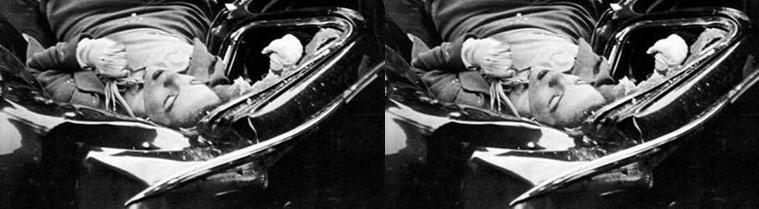
Next: Parenthetical Girls- Evelyn McHale. An absolutely sumptuously shot video accompanies probably my favourite single of the past year- and the tale behind the track was/is the rather beguiling picture that also heads this blog, of a certain... Ms. Evelyn McHale. Look her up- the story makes for a fascinating read, and the full picture (known, somewhat tellingly, as "The Most Beautiful Suicide", and the inspiration for an Andy Warhol print) is oddly hypnotic.


The opening track from the irresistably charming Johnny Flynn's first album, A Larum. The song's called The Box, and this video was made for an excellent series of which you may or may not be aware: the takeaway shows by La Blogotheque. Originally (I believe they've branched out...) all shot in and around Paris, placing musicians in odd and unusual performance spaces, I could happily post a whole series of them (and have, on facebook... much to my later embarrasment re: the effusive praise I gave) but this is a favourite. Equally worth your while are: Architecture In Helsinki, Yeasayer, Grizzly Bear, Beirut and The Tallest Man On Earth's sessions... It's an endless succesion of brilliance, and any list just scrapes the surface. More than worth wasting an afternoon on.


Finally, we have an excerpt from William Basinski's Disintegration Loops. It'd be difficult to give a quick and easy precis of the loops' genesis here, but if you're interested, the wikipedia page (or, indeed, the notes accompanying this video on youtube) explains. Stunningly beautiful stuff, and sososo much more than the 'ambient music' tag it seems to get hit with. This is what forward-thinking music ought to be: evocative, interesting and ultimately deeply moving.


Finally, if you're interested, my holiday reading currently stands at:
-Two books on the philosophy of law;
-Kundera's The Unbearable Lightness Of Being;
-Neruda's Twenty Love Poems and a Song of Despair;
-
Ginsberg's Howl, Kaddish and other poems;
-
Joyce's Dubliners;
-A book on the Nuremberg war crimes trials;
-The Odyssey;
-
A collection of Will Self's essays, Feeding Frenzy;
-A book about young British artists and the Great War, entitled A Crisis of Brilliance;
-
and although not strictly reading, I have a a shitload of letters I've promised to write to friends...

Piece o' piss. Take care, o irregular reader, and I'll be returning in two weeks, or thereabouts- unless I decide to go native and never return to civilisation or the wuh wuh wuh. Which isn't massively likely.